Glasgow’s relationship with slave societies was central to Adam Smith’s account of international trade in Wealth of Nations. Contrary to accepted wisdom at the time, Smith viewed the closed mercantile system between Great Britain and its colonies in the Americas as detrimental to national economic growth. He did acknowledge, however, that the system made ‘special interests’ remarkably wealthy.
The Tontine Rooms, a hotel, coffeehouse and assembly hall where Glasgow’s merchant elites socialised, was just around the corner from the Old College of Glasgow University, where Smith lived and taught. Smith would have encountered colonial merchants with interests in America and the West Indies – daily. It is reputed that Smith was personal friends with Andrew Cochrane of Brighouse (1693-1777), one of Glasgow’s infamous ‘tobacco lords’ and partner in merchant firm Cochrane, Murdoch & Company. Both attended the Political Economy Club and, as patron of the club, Cochrane provided Smith with evidence from his trading experience that informed Smith’s ideas.
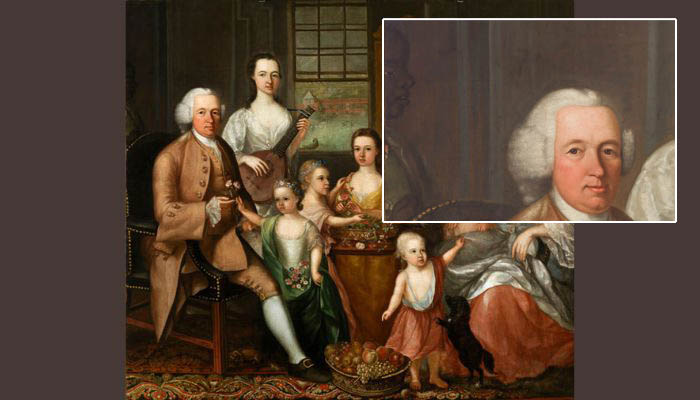
When the American Revolutionary War ended Glasgow’s tobacco monopoly, the city’s merchants re-focused on the British West Indies. The subsequent imports of sugar and especially cotton, grown on slave plantations in Caribbean, underpinned Scotland’s Industrial Revolution (c.1778-1830). Could Smith have foreseen how the mercantile monopoly facilitated by these “special interests” would underpin the development of modern Scotland, even after the collapse of the mercantile system and the loss of the American colonies?
Main image: Port Glasgow from the South East, courtesy of Glasgow Museums