
The Wealth of Nations was published on 9 March 1776 by the London publisher William Strahan, and it had been a very long time coming. Adam Smith had been thinking about its arguments for decades.
About the book
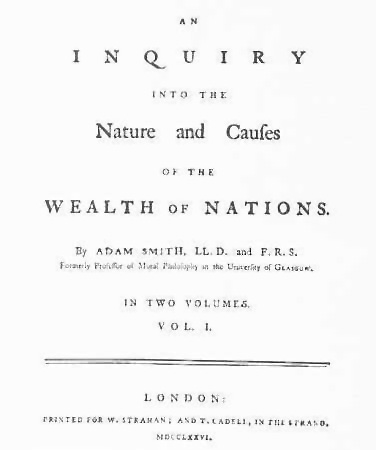
The intellectual foundations were laid during his time as a professor at the University of Glasgow, where he taught moral philosophy from 1751 to 1764. Glasgow in this period was one of Britain’s most dynamic commercial cities — the “golden age of tobacco” was at its height, and Smith’s daily encounters with the city’s merchant elite gave him unparalleled access to how trade actually worked, as distinct from how theorists imagined it. He was reputedly close friends with Andrew Cochrane, one of the most powerful tobacco merchants in the city, and attended the Political Economy Club where merchants debated the principles of commerce that Smith was simultaneously subjecting to rigorous analysis. The manuscript notes of his Glasgow lectures, preserved in the University’s Special Collections (MS Gen. 109), show ideas that would appear in The Wealth of Nations already taking shape more than a decade before publication.
In 1764, Smith left Glasgow for an unusual interlude: he was engaged as a private tutor to the young Duke of Buccleuch and spent several years travelling Europe with his aristocratic pupil. The journey took him to France, where he met Voltaire, François Quesnay (the founder of the physiocrat school of economics), and Turgot — the leading economic thinkers of the age. These encounters sharpened Smith’s arguments and exposed him to the best economic thinking on the continent, much of which he agreed with and some of which he decisively rejected. It was in France that Smith reportedly began drafting the manuscript in earnest.
He finished the book in Kirkcaldy, his home town on the Fife coast, where he retreated from 1767 and spent a decade of intensive writing and revision. “I am a slow, a very slow workman,” he wrote to a friend, “who do and undo everything I write at least half a dozen of times before I can be tolerably pleased with it.” When the book finally appeared, Smith was anxious about its reception — writing to his publisher William Strahan to ask, plaintively, whether the new edition “is Published? does it sell well? does it sell ill? does it sell at all?”
It sold extraordinarily well. The Wealth of Nations became one of the bestselling books of its age — a genuinely popular work in an era when popular non-fiction was itself a new phenomenon. The novel had barely been invented; books written for a general educated readership, rather than scholars or clerics, were a recent and exciting development made possible by the expansion of the printing trade. Within two years of publication, The Wealth of Nations had been translated into French and was circulating in continental Europe; a copy of the French edition was sent to Benjamin Franklin in Philadelphia. The book appeared in the library of an East India Company civil servant in Calcutta by 1781. John Adams was recommending it to his son by 1790 as essential reading for anyone who wished to understand politics. Governor Pownall in Massachusetts Bay wrote to Smith calling it a work that might “fix some first principles in the most important of sciences” — the “principia” of political economy.
The book’s influence was inseparable from the moment of its publication. David Hume had urged Smith not to wait for the resolution of the American Revolution before publishing: “If you wait till the Fate of America be decided, you may wait long.” Smith didn’t wait — and the result was that his analysis of colonial monopoly, corporate power, and the costs of empire appeared at precisely the moment when its arguments were most urgently needed, most widely debated, and most quickly read by the people who would shape the world it was written about.
Listen: Dr Maha Rafi Atal and Dr Craig Smith talk about Smith and his legacy
Book: Compounding Interest: Revisiting the Wealth of Nations at 250