
In 1776, Java was the centre of the V.O.C.’s empire. The Indonesia archipelago produced a variety of products desired back in Europe, including sugar, coffee, tea, rice, tapioca, pepper, mace, cloves, nutmeg and tin. From Batavia (modern-day Jakarta), a port town founded by the V.O.C. in 1619, the V.O.C. collected these products for transportation back to Europe. Most trade between the Netherlands and Asia was mediated through Batavia. As a result, the town had grown immensely, and by 1776, Batavia and its surrounding environment (the Ommelanden) was home to over 130,000 people.
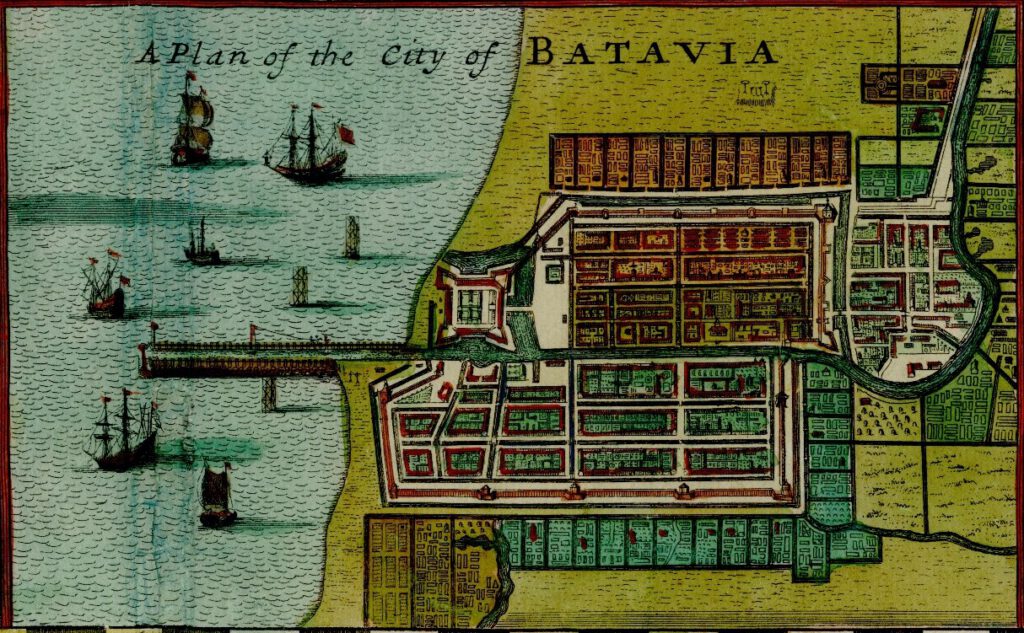
Though Java’s famous sugar production would take off in the 19th century, our sailor would see the beginnings of the sugar industry during the 18th. Much of this production came outside of the walls of Batavia itself, instead happening in its Ommelanden. These sugar plantations and sugar mills relied heavily on the knowledge of Chinese immigrants to the region and on enslaved labour. Since the VOC was forbidden from enslaving Javanese people, many slaves were taken from Ceylon (Sri Lanka), or the Malabar Coast in the south of India. The Javanese could, however, be subject to debt bondage or corvée obligations (unpaid forced labour in place of some taxation). In this latter capacity, many were used for temporary tasks, such as seasonal work or unloading large ships. Inner Batavia also had a system of free market labour. Between 1765 and 1811 there were at least 65 edicts from the V.O.C. addressing the setting of wage levels for different kinds of labourer according to both race and skill level.
The V.O.C. also put the surrounding islands to use. Onrust Island (Pulau Onrust/Pulau Kapal) was home to a shipyard, as well as medical and supply facilities. Captain Cook wrote approvingly of this shipyard when he visited in 1770: “I must say that I do not believe that there is a marine yard in the world where work is done with more alertness than here, or where there are better conveniences for heaving ships down both in point of safety and despatch.” (Beaglehole, 1955, p.438).
As with Cape Colony, V.O.C. control of Java was not to last. Our sailor arrives on the eve of the fourth Anglo-Dutch war (1780-84), which will set Dutch imperial power into permanent decline. Moreover, despite the vast revenues brought in by outposts such as Java, the V.O.C. struggled to generate profit, eventually collapsing into bankruptcy in 1799. Following its collapse, Batavia and many other V.O.C. outposts were subjected to French rule, before falling to the British after the defeat of Napoleon in the early 19th century.
Smith did not live to see these upheavals, but in Wealth of Nations, he had already warned that the mercantile system based on monopoly trading corporations would be both economically unproductive and politically ruinous.
Main image: View of the south coast of Java, by Franz Wilhelm Junghuhn, Rijksmuseum, public domain